After the 11th of September 2001, as told by James Parker, former Southwest CEO, in his book “do the right thing”: the first business decision we faced was what to tell our customers who would be calling to cancel their flight reservations. Even before we had established contact with all of our flights, the Customer Relations and Reservations agents had to know what to tell customers who would want to cancel their flights and get a refund. When I walked into the office of our president, Colleen Barrett, on the morning of 9/11, it was clear that we had to make an instantaneous decision. The head of our Customer Relations department, Jim Ruppel, arrived, he knew the calls would be coming. Colleen’s first instinct was the same as mine. In the absence of any real information, we simply decided to follow our gut and do what we perceived to be the right thing. We decided that any customer who asked for a refund could have it, no questions asked, with no penalties or refund fees.
It was not only the right thing for customers that the management had to do but also for the employees, as James Parker continued: We all knew that passengers would be hard to come by. All of the other major airlines announced that they were reducing their flying capacity by 20%, grounding 20% of their airplanes, and dismissing 20% of their employees… With the full support of our board of directors and the leadership of the chairman of our board, Herb Kelleher, we decided that Southwest would not lay off employees, not ground any of our airplanes and not cut the pay of our employees. And we would pay the $179.8 million to our employees’ profit-sharing plan on time, on September 14!
How did our customers respond? The anticipated flood of refund requests simply never came. On the contrary, many people called and wrote offering to send us money or forego their refunds.
How did our shareholders respond? Not a single one told us that we should have followed the herd by grounding airplanes and firing employees… On the contrary, many told us that they fully understood our culture and they considered it our most unique and powerful competitive advantage. While the value of Southwest stock was affected by 9/11 and its aftermath, for an extended period of time, the market value of Southwest was greater than that of all the other major airlines combined.
And how did our employees respond? Faced with a continuing flow of ever-changing new federal security requirements, many of our employees worked around the clock, pitching in and doing whatever was required. They knew what the dismissed employees at other airlines were going through, and they were as determined as I was to see that it never happened at Southwest.
How does Southwest achieve this? Every company has a significant purpose, “The real reason” for existence. It answers the question “Why?” rather than just explaining what you do. It clarifies, from the viewpoint of your people and your customers, what business you are really in and where they fit into the equation.
For Colleen Barrett, Southwest’s President from 2001 to 2008 and currently President Emeritus, Southwest is in the Customer Service business—they just happen to provide airline transportation. It’s that simple. But it focuses all the energy of their People on taking care of their Customers.
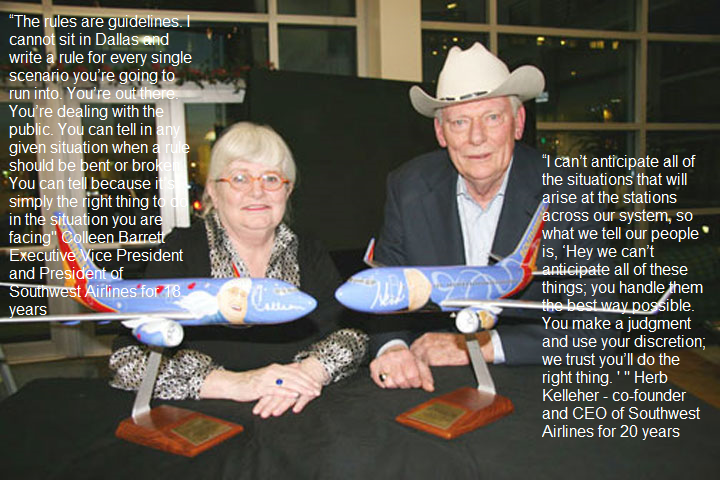
Colleen in the book she co-authored with Ken Blanchard mentioned: we empower our People to use common sense and good judgment. We have written rules and procedures, and you can go look at them, but I say to our folks every day, “The rules are guidelines. I cannot sit in Dallas and write a rule for every single scenario you’re going to run into. You’re out there. You’re dealing with the public. You can tell in any given situation when a rule should be bent or broken. You can tell because it’s simply the right thing to do in the situation you are facing,… Our People understand that as long as the Customer Service decisions they make are not illegal, unethical, or immoral, they are free to do the right thing while using their best judgment—even if that means bending or breaking a rule or a procedure in the process”.
It was exactly in line with what Herb Kelleher, Southwest co-founder, CEO and president from 1978 to 2001, Executive Chairman up to 2008 and Chairman Emeritus since 2008, said in a 1991 Nation Business interview: So what we tell our people is, ‘Hey we can’t anticipate all of these things; you handle them the best way possible. You make a judgment and use your discretion; we trust you’ll do the right thing. If we think you’ve done something erroneous, we’ll let you know—without criticism, without backbiting.’
For over four decades, Southwest has made living legends of employees who went above and beyond the call of duty to offer exceptional customer service.
But what sort of “do the right thing” Southwest’s people have been doing over the years? It is hard to select through all the stories, but here are a few examples:
Probably the most incredible for me is the one mentioned by James Parker: one snowy night before Thanksgiving, one of our planes landed in Chicago, it had one more flight scheduled to Detroit. In Chicago, all the Chicago-bound passengers got off—all except for one young girl who was confused about where she was. The plane reloaded and took off for Detroit. When it arrived, all passengers got off—except for the young girl, whose family was now in a panic in Chicago wondering where their daughter was. It was our mistake, no doubt about it. And when the captain figured out what had happened, he knew what he was going to do about it. He didn’t ask for permission; he just did it. He asked his flight crew to climb back on the airplane and told the Detroit station to call Chicago to let the girl’s parents know their daughter was coming. I don’t know how much money that unscheduled round trip between Detroit and Chicago cost us that night, but I sure was proud when I heard the story. Once again, our people just did the right thing.
After 9/11 some airplanes get stranded in the middle of nowhere for 3 days, some flight crews took their passengers to movies. One crew, which was marooned in a city where Southwest did not fly, took their passengers bowling. The pilots and flight attendants just pulled out their credit cards and did what was necessary to care for their passengers. They don’t call and ask, “Is it okay? Will I get reimbursed?”
The own experience of Ken Blanchard that he mentioned in the book written with Colleen Barrett: a number of years ago, I was heading to the airport for a trip. As I approached the airport, I realized that I had forgotten my driver’s license and didn’t have my passport, either. Only one of my books, Everyone’s a Coach, written with the football coach of the Miami Dolphins, Don Shula, has my picture on the cover. So when I got to the airport, I ran into the bookstore; luckily, they had a copy of that book. As I was checking my bag, the Skycap (a porter at an airport) asked to see my identification. I said, “I feel bad. I don’t have my driver’s license or passport. But will this do?” and I showed him the cover of the book. The Southwest Employee shouted, “This man knows Don Shula! Put him in first class!” (Of course, you don’t have a first class section.) Then one of the older Skycaps said, “Why don’t I go in the terminal with you? I know the folks at Security. I think I can get you through.” And that’s exactly what he did.
This letter sent to Southwest : I’m writing to thank you for the excellent service Southwest has provided our family. Our 11-year old son has travelled several times with you as an unaccompanied minor, and it is always uneventful. Recently he once again geared up for a flight when the second leg of the flight was delayed, we got a call from him letting us know.
It was a nice touch when the pilot came on the phone and let us know the exact situation and reason for delay. We were surprised the captain took the time to speak to us personally… Imagine our surprise when we later found out that the captain took our son to dinner with the rest of the pilots to the airport McDonald’s. For an 11-year old, hanging out with the pilots was really cool! The captain could have easily left someone to babysit our son while they got dinner, but by including him, it made his day.
Southwest has once again confirmed that it is a people-oriented, truly friendly operation. We will keep coming back.
And just one last one from the book “Nuts! Southwest Airlines crazy recipe for business and personal success”. By Kevin and Jackie Freiberg: Kelleher loves to tell a story about Gigi Perry, a customer service agent at Love Field in Dallas. A 70 year old woman who had recently had heart surgery was bound for Amarillo, Texas. Her flight was grounded in Dallas because of heavy fog in Amarillo. Some two and a half hours after the bus had left to take the stranded customers to a hotel, Gigi noticed the woman outside the terminal, standing on the curb. Gigi drove the woman to the hotel and stayed with her the entire night because the elderly woman was afraid to be alone. The next morning, Gigi saw to it that the woman made her departure and then arrived in Amarillo safely. “Our people do that type of thing all the time,” Kelleher says. “I mean, they have big, big hearts.”
How does Southwest Airlines achieve that so many of their employees just “do the right thing”?
For Jim Ruppel: “Southwest equips people to do the right thing by giving them opportunities to learn through watching. When an individual who is new to Southwest actually observes somebody taking that extra step or going the extra mile, it becomes contagious. Doing the right thing is not something people do for a reward; they do it because that’s who they are. We all have that gene somewhere within us. Doing the right thing gives us pride in the work that we do, and we all have a need to feel good about what we do.” Yet at one point or another, our perception of others’ behaviour directly influences our own.
Southwest has learned that when employees are trusted to apply a little common sense and ingenuity to a problem, several things happen.
First they come up with far better solutions than the company could have dreamed of mandating.
Second, they can quickly respond to customers’ demands.
Finally they can direct their energies toward seizing unique market opportunities when time is critical.
Southwest employees know that Southwest has one overriding plea to all our people—when in doubt, just do the right thing. It may be a somewhat subjective standard, but it usually lead to good results. It requires our people to use their heads.
The Southwest story demonstrates over and over that people will act responsibly and do more than expected when they are given the freedom to think on their own. People will work hard when they have the freedom to do their job the way they think it should be done.
 afewprinciples